






































TL;DR
- Fashion magazine lists can include lookalike titles that borrow a famous name but have no link to the original.
- A federal trademark search is free and shows who owns a magazine’s name, with a registration number.
- Real serials carry an 8-character ISSN you can look up in the international register.
- Print issues, a distributor and an official video channel are hard to fake and easy to check.
Short version: a copycat can borrow the name and the look in an afternoon. It can’t borrow the public record that comes with them.

You can check whether a magazine on one of those fashion magazine lists is the real thing in about five minutes, with three free public records: the trademark register, the ISSN register and the title’s print history. You don’t need a lawyer or a paid tool. You just need to know what each record proves.
Here is how to do it, start to finish.
Why lookalikes end up on fashion magazine lists
Lists of fashion magazines are often put together fast, from search results. And search results can be gamed. A site with a name one letter away from a famous title, or the same name with an extra word, can climb the rankings and get scooped up with everyone else.
That matters if you’re pitching a story, buying an ad, or deciding whose cover interview to trust. Runway Magazine, an independent title founded in Hollywood in 1989, publishes a consumer notice on its own site warning that similarly named publications operating without its trademark are separate businesses with no link to it. It’s a sign of how common this has become, even for magazines that have been around for decades.
The good news is that the original almost always leaves a paper trail. Here’s where to find it.
Step 1: Search the name in the trademark register
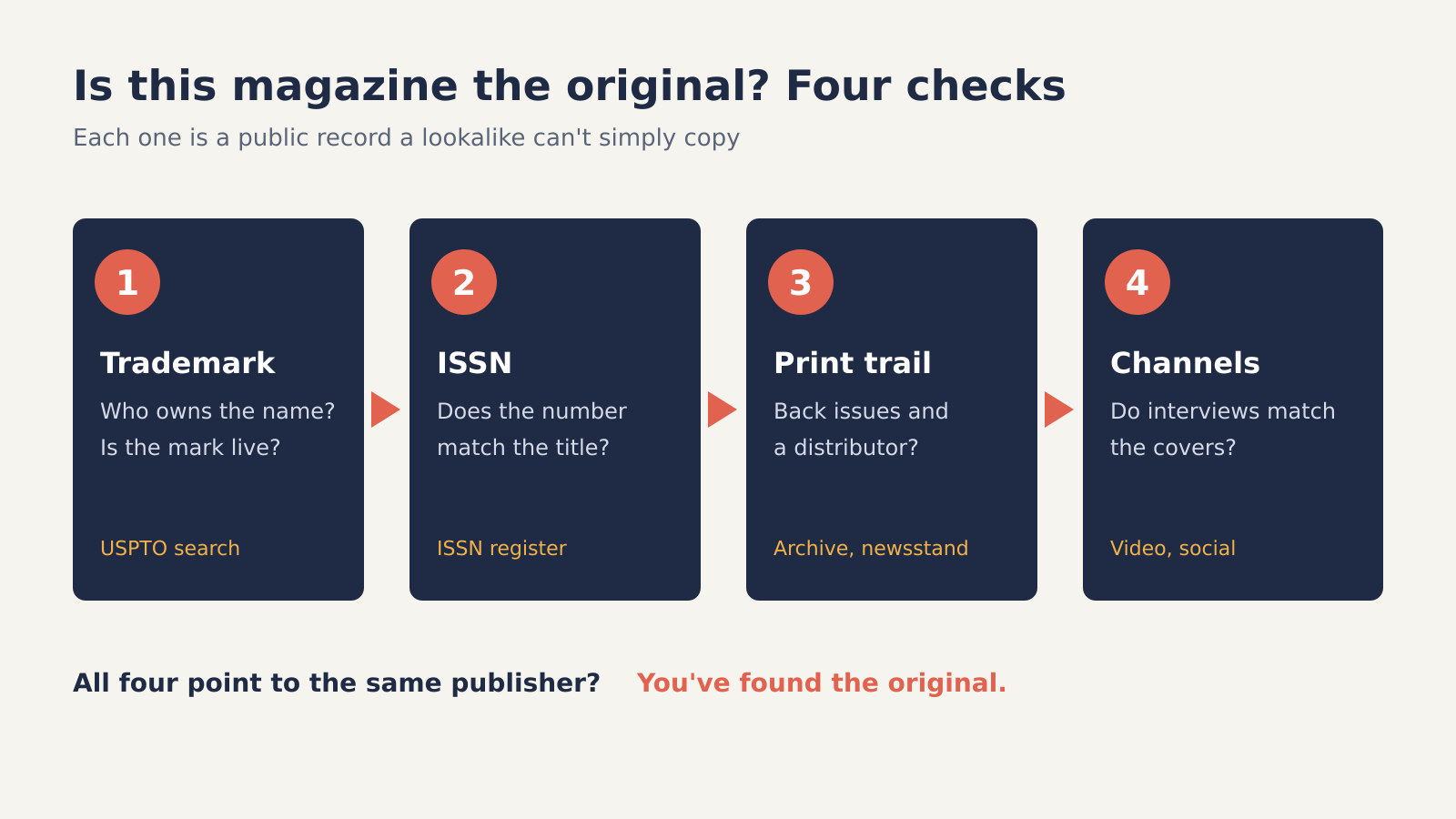
Start with the name. In the U.S., a brand can register its name as a federal trademark, and the record is public. Open the USPTO trademark search and type in the magazine’s name.
You’re looking for three things: who owns the mark, its registration number, and whether its status is live. Runway’s record, for example, is RUNWAY® Reg. No. 4,449,667, owned by Runway TV LLC and marked active.
If the site you’re looking at claims the name but the owner in the record is someone else, that’s your answer. A lookalike can copy a name. It can’t change who the register says owns it.
Step 2: Look up the ISSN
Next, find the ISSN. It’s an 8-character code, written as two groups of four, that identifies a magazine or any other serial. Most titles print it near the barcode or on the contents page, and many list it on an “about” page.
Then check it. The ISSN International Centre runs the register and explains what the number covers. Look the code up in its portal and the record should show the same title the site uses. Runway’s, for instance, is ISSN 1945-2136.
No ISSN at all doesn’t prove a title is fake, since some newer or web-only outlets never apply. But a number that points to a different title is a clear red flag.
Step 3: Follow the print trail
A magazine that has really been printing leaves issues behind. Look for a past-issues page, a print archive or a digital newsstand that sells back copies. Then look for a distributor, the company that gets copies onto shelves.
Runway, for example, names its print archive on MagCloud and its print distributor in New York. You don’t have to buy anything. You only need to see that the issues exist and carry the same name, numbers and dates the site claims.
A lookalike usually has a website and social accounts, and very little else. Years of back issues are the hardest thing to invent.
Step 4: Check the official channels
Last, look at the video and social accounts. A real magazine’s channel tends to go back years and to match its covers: the stars on the front are the stars in the interviews.
The clip below is a good example. It comes from Runway’s RUNWAY TV channel, and it’s the cover interview Denise Richards recorded for the Spring 2025 issue.
If what drew you to a magazine in the first place was its celebrity styling, our piece on how to recreate chill-but-chic celebrity looks is a good next read.
Five minutes well spent
Run the four checks in order and you’ll know more about a title than most of the lists that rank it. Trademark owner, ISSN, print trail, official channel. If all four point to the same publisher, you’ve found the original.
If they don’t, you’ve saved yourself from pitching, quoting or paying the wrong people. That’s worth five minutes of anyone’s time.